Calculates Cliff's delta (Cd) as a non-parametric effect size for
comparing two numeric vectors. Cd quantifies the directional difference
between a reference (ref) and comparison (comp) distribution
based on pairwise comparisons of their values.
Cd ranges from -1 to 1, where:
-1: values in
compare consistently larger than those inref0: both distributions are similar, with no systematic difference
1: values in
refare consistently larger than those incomp
Details
The effect size is calculated as the scaled difference in dominance between groups. Missing or infinite values are removed with a message. Synonyms are
References
Cliff, N. (1993). Dominance statistics: Ordinal analyses to answer ordinal questions. Psychological Bulletin, 114(3), 494–509. doi:10.1037/0033-2909.114.3.494
Examples
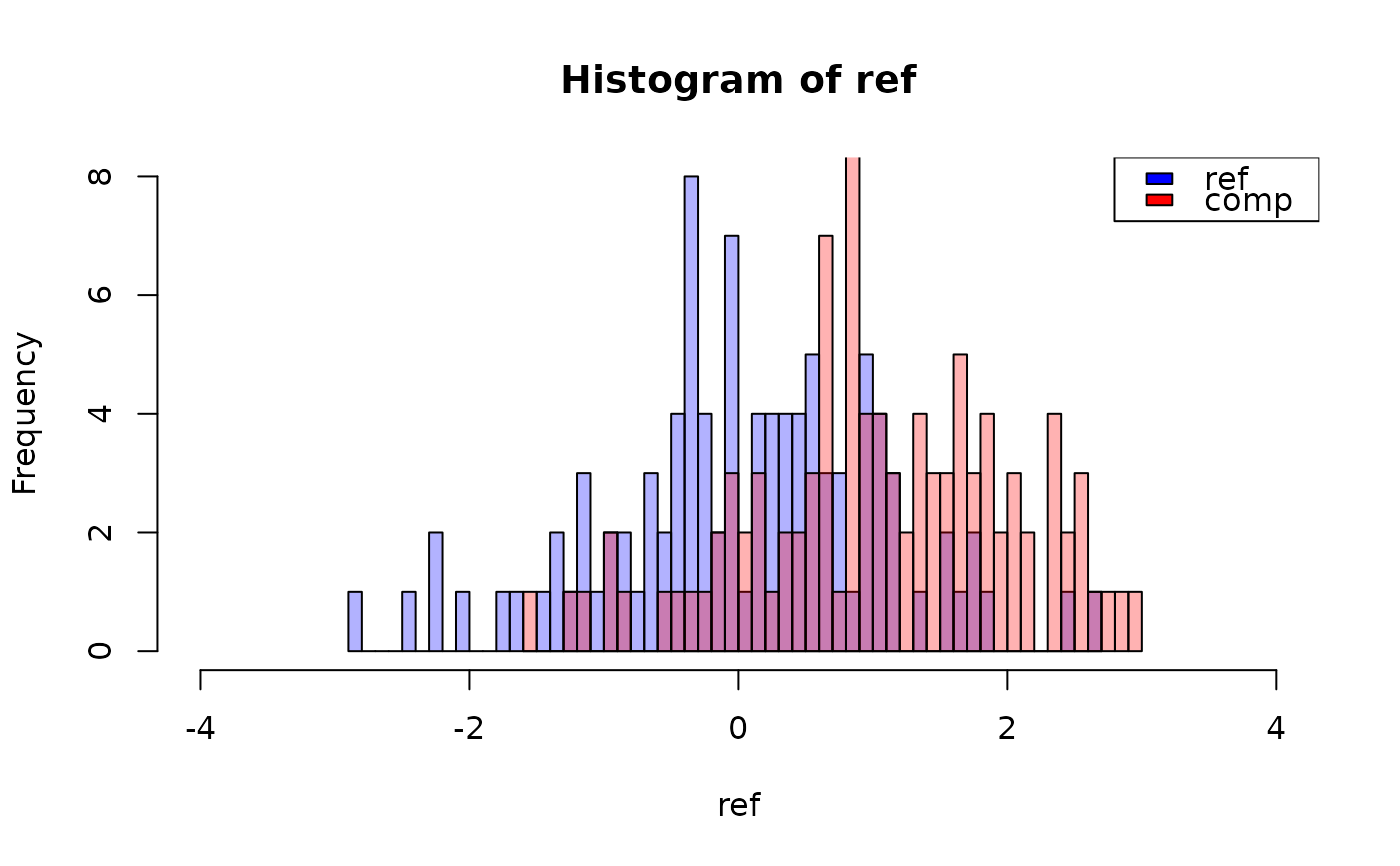
ref <- rnorm(100, mean = 0)
comp <- rnorm(100, mean = 1)
hist(ref, col=rgb(0,0,1,0.3), breaks=50, xlim=c(-4,4))
hist(comp, col=rgb(1,0,0,0.3), breaks=50, add=TRUE)
legend("topright", legend=c("ref","comp"), fill=c("blue","red"))
 cliffs_d(ref, comp)
#> [1] -0.532
cliffs_d(comp, ref)
#> [1] 0.532
comp1 <- rnorm(100, mean = 10)
cliffs_d(ref, comp1)
#> [1] -1
cliffs_d(ref, ref)
#> [1] 0
cliffs_d(ref, comp)
#> [1] -0.532
cliffs_d(comp, ref)
#> [1] 0.532
comp1 <- rnorm(100, mean = 10)
cliffs_d(ref, comp1)
#> [1] -1
cliffs_d(ref, ref)
#> [1] 0